

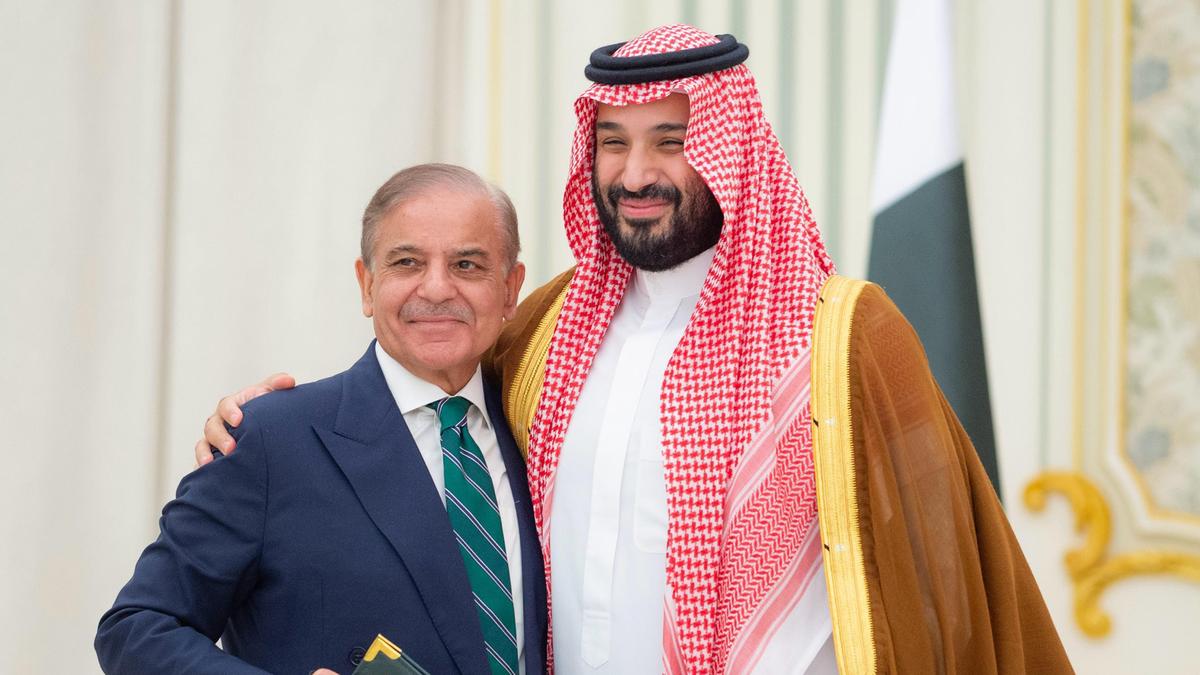
On 17 September 2025, Pakistan and Saudi Arabia signed a historic defence agreement that is being called a strategic breakthrough for Islamabad and a diplomatic surprise for New Delhi. The pact, which declares that an attack on one state will be treated as an attack on the other, places a binding duty on Pakistan to assist in Saudi security matters, particularly in the protection of the Two Holy Mosques.
The development is not just a formalisation of decades-long defence ties between Islamabad and Riyadh—it is also a regional game-changer that reshapes Gulf–South Asia dynamics and signals a new phase of Pakistan’s foreign policy outreach.
Formalising Long-Standing Trust
Pakistan and Saudi Arabia have historically shared close defence ties. Pakistani military personnel have been training Saudi forces for decades, and joint exercises have been routine. However, the 2025 defence pact goes further: it translates unwritten cooperation into a clear, legal framework.
Key aspects include:
- Converting long-standing military practice into a written security treaty.
- Explicit political and military backing in case of a security threat.
- The addition of a strong moral and religious dimension through the protection of holy sites.
- Public recognition of Pakistan’s military credibility by Saudi Arabia.
- Establishing a transparent legal basis for future security cooperation.
This formalisation signals Riyadh’s trust in Islamabad and reinforces Pakistan’s role as a reliable security partner in the Gulf.
Diplomatic Gain For Pakistan
Islamabad has projected the deal as a major diplomatic achievement. At a time when Pakistan has faced economic and political instability, securing a landmark agreement with a leading Gulf state is being hailed as proof of Pakistan’s resilience and global relevance.
The diplomatic benefits for Pakistan include:
- Strengthening Islamabad’s voice in Gulf security affairs.
- Enhancing Pakistan’s image as a trusted partner of the Muslim world.
- Countering narratives that Pakistan is internationally isolated.
- Building diplomatic capital to leverage in other bilateral and multilateral forums.
- Creating new avenues for economic and strategic cooperation.
For Pakistan’s leadership, this agreement is more than a security pact—it is also a foreign policy victory to showcase at home and abroad.
Military Credibility and Air Power
Saudi Arabia’s decision to formalise this pact is also a vote of confidence in Pakistan’s military strength, particularly its air force and counter-terrorism expertise. Riyadh has often leaned on Pakistan for military training and operational planning, and this agreement cements that reliance.
Why Pakistan’s defence capability matters in this deal:
- Pakistan’s military is widely respected for its professionalism and operational readiness.
- The Pakistan Air Force (PAF) is seen as a credible deterrent with proven regional capabilities.
- Regular training missions and security cooperation have created deep institutional trust.
- Pakistan’s nuclear-armed status adds another layer of strategic credibility.
- The pact underscores Islamabad’s status as a capable security provider, not just a recipient of aid.
For Pakistan, the agreement is a public recognition of its strategic worth in global security terms.
A Clear Message to India
One of the most striking aspects of the agreement is how it has been positioned in Pakistan’s political discourse. Senior analyst Mushahid Hussain Sayed described the pact as a “surprise for India”, pointing out that New Delhi did not anticipate this development.
The surprise element matters because India has, in recent years, tried to strengthen its outreach to the Gulf states, particularly Saudi Arabia and the UAE. This deal challenges those efforts by proving that Pakistan still holds privileged trust in Riyadh’s security calculations.
Implications for India:
- New Delhi is forced to reassess its Gulf diplomacy.
- The pact undermines India’s claims of sidelining Pakistan in the Middle East.
- It exposes gaps in India’s ability to anticipate or counter Pakistani moves.
- The development fuels domestic criticism of Modi government’s foreign policy blind spots.
- India must now recalibrate its Gulf strategy to prevent further diplomatic setbacks.
For Islamabad, the “surprise factor” is a psychological and diplomatic victory.
Political Cost for India’s Leadership
In India, the agreement has already sparked questions about missed opportunities. Analysts argue that New Delhi underestimated the depth of Pakistan–Saudi military ties and failed to anticipate Riyadh’s decision.
Strategic costs for India include:
- A dent in India’s Gulf outreach strategy, which aimed to reduce Pakistan’s influence.
- Reinforcement of perceptions that Indian diplomacy is overly self-focused.
- A new talking point for opposition voices to criticise Modi’s foreign policy.
- Evidence of Pakistan’s ability to outmaneuver India on specific diplomatic fronts.
- A warning sign for Indian policymakers to invest more in regional foresight.
Thus, while Pakistan celebrates, India is left to confront the political costs of strategic oversight.
Religious and Public Resonance In Pakistan
A defining element of the pact is its link to the protection of the Two Holy Mosques. This has given the agreement a deep moral and religious resonance in Pakistan, where public sentiment strongly favours defending Islam’s holiest sites.
Domestic impact of this framing:
- Broad public approval of the agreement across political divides.
- Enhanced legitimacy for the government in tying foreign policy with religious duty.
- Creation of a national pride narrative rooted in faith and security.
- A strengthened sense of Pakistan’s leadership role in the Muslim world.
- Broader international appeal among Muslim-majority countries.
By linking the pact to faith, Pakistan’s leaders have ensured that it resonates beyond strategic circles into the public imagination.
Limits And Practical Tests Ahead
Despite its symbolic weight, the agreement will only prove meaningful if it translates into practical steps. Defence cooperation requires more than words—it demands logistics, planning, and sustained political will.
Challenges ahead:
- Establishing joint command structures and training modules.
- Sorting out logistical frameworks for rapid deployment.
- Ensuring political commitment despite changes in leadership.
- Balancing Saudi expectations with Pakistan’s own security priorities.
- Demonstrating real results through joint exercises and operational planning.
The agreement will be judged not just by its symbolic power, but by the practical cooperation it produces.
Conclusion: A Win for Pakistan And A Wake-Up Call For India
The Pakistan–Saudi defence agreement of September 2025 is a landmark event in regional geopolitics. For Islamabad, it is a diplomatic victory, a military recognition, and a point of national pride. For India, it is a diplomatic setback that forces a rethink of Gulf strategy.
By tying the agreement to the protection of the Two Holy Mosques, Pakistan has also ensured strong domestic and international support. However, the true test will come in the implementation phase, where promises must translate into real military and diplomatic cooperation.
Until then, Islamabad will continue to project the deal as proof that Pakistan remains a trusted partner in the Muslim world—and a regional actor that India cannot ignore.